
Screenpipe vs Littlebird — the open-source alternative
Full 24/7 screen + audio memory vs active-window reading
The Verdict
Littlebird does one thing well: it reads the text of your active Mac window and turns it into suggestions, quick drafts, and a daily journal. Clean product, solid execution on that scope. Screenpipe is a different shape of tool — it records every screen and microphone continuously, across Mac, Windows, and Linux, and keeps everything on-device. You then ask AI anything about what you've seen or heard, or build pipes that act on that memory automatically (meeting notes, CRM updates, daily summaries). If you just want a smarter Mac assistant for active-window workflows, Littlebird is a real choice. If you want complete digital memory plus the ability to wire it into the tools you already use, Screenpipe is the category match.
Why Screenpipe Wins
Simple window reader vs complete 5-layer screen memory
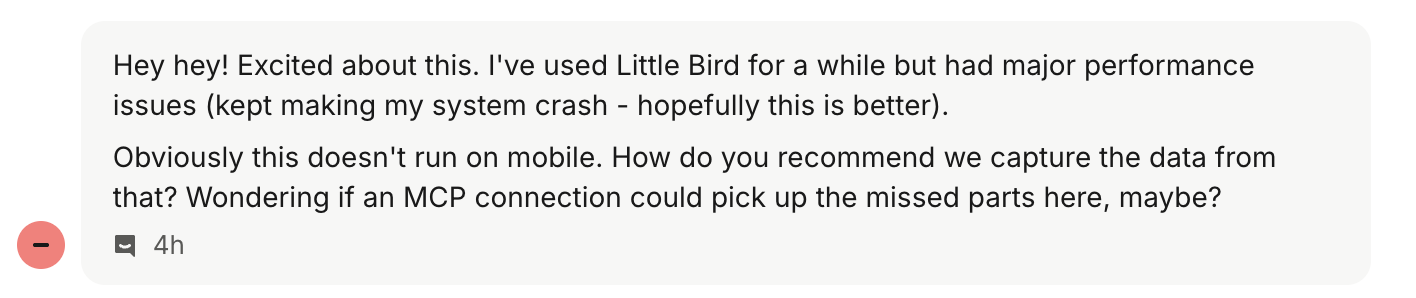
Matt Mullenweg, WordPress co-founder — responding to Littlebird's launch

real user feedback
At a Glance
Different shape of product
Littlebird is a smart assistant that reads your active window. Screenpipe is a recorder that captures everything continuously and then lets AI agents use that memory. Both are useful; they solve different jobs. If the question is 'help me with what I'm looking at right now', Littlebird is a fair answer. If the question is 'find that thing I saw on Tuesday' or 'write my weekly update from this week's calls', that's a screenpipe job.
All monitors vs one window
Multi-monitor users notice the gap quickly. Littlebird only sees the active window — context from a second display or background app is invisible. Screenpipe captures every monitor simultaneously.
Auditable trust
Screenpipe is MIT-licensed on GitHub. Anyone can verify what the app records, where it stores it, and what (if anything) it sends out. With closed-source cloud tools you're trusting the vendor's word on privacy. For software that sees your screen all day, the ability to verify matters.
Works everywhere you work
Cross-platform matters if you use a Mac at home and Windows or Linux at work, or if your team is mixed. Littlebird is Mac-only on the desktop. Screenpipe runs on Mac, Windows, and Linux with the same features.
Littlebird: pros & cons
Where Littlebird Is Strong
- Clean Mac-native experience
- Smart context suggestions from your active window
- Meeting notes and daily-journal generation
- Chat-based iPhone companion for querying your data
Limitations
- Mac desktop only — no Windows or Linux
- Active window only — misses content on other monitors or background apps
- Processes your content in the cloud
- Closed-source
- No developer API or plugin system
- iPhone app is chat-only; it doesn't record on mobile
Is Screenpipe a Good Littlebird Alternative?
Yes. Screenpipe is a strong Littlebird alternative and Littlebird competitor for anyone who values privacy, transparency, and data ownership. Unlike Littlebird, Screenpipe is open-source, supports local-only capture and search, and works on macOS, Windows, and Linux.
Screenpipe directly compares itself to Littlebird on this page. The key difference: Screenpipe captures your screen and audio 24/7 while keeping core capture local-first. Optional sync, cloud AI, exports, connectors, and team workflows are scoped separately.
Ready for True Data Ownership?
Join thousands who chose open-source, local-first AI memory. Your data stays yours.